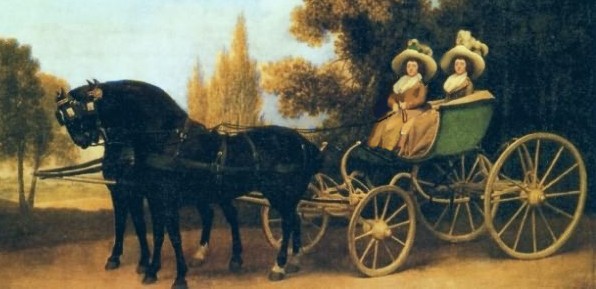
| The Tuesday Afternoon Ladies Driving Club is a private ladies pairs driving group dedicated to the enjoyment of driving horse or pony pairs
in the manner of the elegant ladies of yesterday. We strive to maintain the high standards of driving pairs for personal pleasure
in beautiful settings, and to always to be turned out in an impeccable manner. We feel that no lady who drives pairs can have too many hats!
Our drives are exclusively for
our own personal pleasure, and those of our guests.
To contact us please email us at taldc @ aurigafarm.com (please remove spaces)
We cordially invite you to click on the links below to enjoy the photos of our carriage drives.
History of the Lady's Carriage
Historically in medieval times ladies in carriages were relegated to the status of exhalted passengers. Their
conveyances, which were subject to the horrors of rutted roads and rough travel, were driven by
servants and hired drivers. The lady was safely protected from the grime of the road, and the curiosity of the public eye,
by riding in the interior of the conveyance, appropriately with drawn curtains. She was there simply to travel -- not to be
seen.
It wasn't until the early 16th century that the lady began to move from the
interior to the exterior of the carriage. Travel by carriage was becoming more popular as road improved in the cities, and trades demanded better
road conditions through the countrysides. Toll roads were developed with better surfaces that allowed for faster, more comfortable
travel. Riding in the interior of the carriage was still preferred in bad or foul weather, and when traveling anywhere outside her own
neighborhood. For short jaunts
around the fashionable parts of the city, however, it was becomming more common for the lady to be in an "open air" carriage, in full view
where her dress and accessories could be seen and admired by her peers.
By the 17th century the lady driver came into her glory. At the early part of the 1800's it became fashionable to be seen "taking the air" behind a pair of lovely
horses or ponies with servants in full livery, often with the lady's coachman on the box. By the mid-1800's ladies began taking up the reins, her servant
sitting primly and properly behind his
mistress to be at her beck and call immediately.
Carriage manufacturers saw this trend of the lady driver as a fabulous opportunity to design special carriages specifically for women
with sweeping drops (for the volumous dresses of the era) and arched dashes (to "hide" the "unmentionable" parts of the horses).
The elegance and wealth personified by these beautiful creations swept the social world by storm. Of the four wheel carriages the Victoria
(also called the milord in Europe), the park chaise, the pony phaeton, and the most elegant of all phaetons that became synonomous with
the lady driver -- the George IV and Peter's phaetons -- were the most sought after by ladies of status and weath. Folding Hoods and
removable parasol tops were created so that the lady was protected from sun, wind, and rain... and still be fashionable visible.
By the late 1800's
the popularity of carriages just for women were overwhelming. These carriages were often
put to pairs of matched horses or ponies. "High steppers" of the hackney breed were preferred for traispings about town; Welsh ponies or Thoroughbreds preferred
for distances and traveling to visit friends and family.
The glory that was the open road began to be shared by a new invention -- the motor car-- in the early 1900's.
So swift was this gas-powered invention adopted by the public that by 1910 the carriage had virtually disappeared from the cities, and dying
a slow death in the countryside where they soon were outnumbered by the faster, more powerful engine driven cars. By the 1920's the carriage
was no longer seen on the road. Only the horse show ring continued to herald the beauty of the carriage, allowing ladies to still drive their
pairs to the admiring public, albeit around an oval ring.
Most carriages, however, were stored in old barns and sheds to become the sad victims of destructive mice and time. The once beautiful paint
weathered,
cracked and faded, soft upholstery weakened and shredded, and leather hoods stiffened and cracked as the century marched on. It would be many
years before the carriage would eventually experience a revival.
.
.
.
|